
Transforming Remote Access Software and Company Culture
Background: Evolving My Role
I joined this company as a Software Test Engineer, but as my role expanded, I found myself naturally stepping into what I later recognised as a Product Owner role. Working primarily on mobile apps for iOS and Android, I enjoyed a dynamic, forward-thinking environment, helping implement modern workflows and creating some of the most polished products in the company.
The company’s remote access software had always been a simple tool for IT professionals, requiring technical expertise to configure routers and firewalls. However, a major transformation was on the horizon: a shift toward seamless, automated connections that would require an entirely new user experience. Recognising the absence of a formal UX role in the company – and the immense value it could bring – I took the initiative to bridge that gap, immersing myself in UX research, methodologies and best practices.
The Challenge: Moving to a SaaS Model
The company was transitioning from selling one-time software licenses to a subscription-based SaaS model. This change meant making it easier for customers to manage accounts, maintain subscriptions, and, most importantly, continue paying for the service year after year.
However, there was a critical missing piece: we didn’t truly understand our users. We only interacted with customers when making sales or resolving technical issues, leaving many unanswered questions about their needs, workflows and pain points.
Around this time, a Head of Product was brought in, marking a turning point in my career. We shared a passion for customer research and quickly set out to fill the knowledge gap by talking directly to users.
Getting to Know Our Users
To build a user-centered product, I began conducting interviews with a range of customers. These 30-minute sessions focused on understanding their roles, how they used our software, and what other tools they relied on.
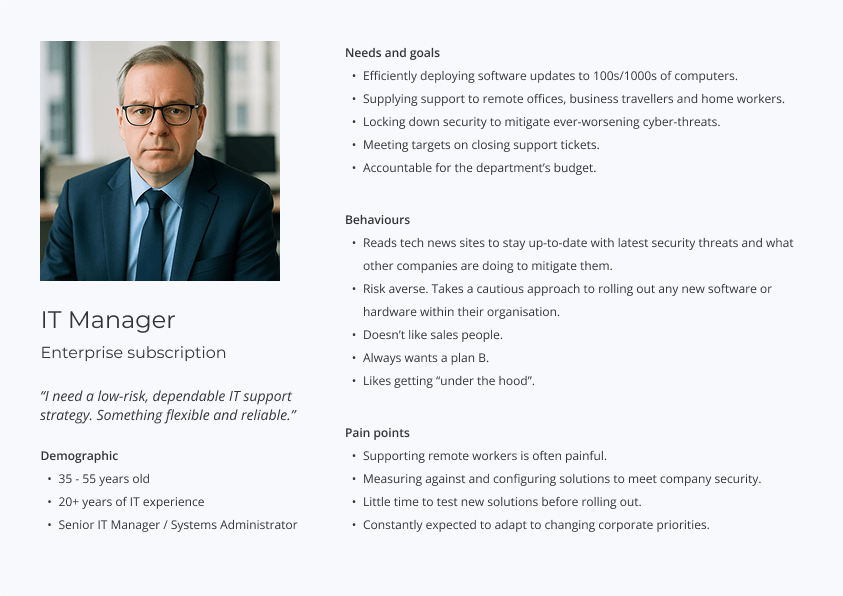
I documented these sessions and used empathy mapping to convey key insights. These findings, combined with survey responses and behavioural data, allowed us to develop a clear set of personas. Our primary user emerged as the IT Manager or System Administrator. To keep these personas front and centre, I created a sharable slide deck and even a set of desk-friendly persona cards for quick reference.
Collaborative Design with Story Mapping
Armed with user insights and business goals, we started defining the key features needed for our new SaaS model: account management, login flows, and an intuitive address book for saved connections.
User story mapping proved to be an effective way to visualise these features while fostering cross-team collaboration. I commandeered a prominent office wall, covered it with post-its and diagrams, and used it as an evolving conversation space. Positioned near the engineering team’s desks and on the main route to the kitchen, it naturally sparked engagement and discussions – just as I’d hoped.

We mapped out scenarios using our primary persona and iterated on the flow, ensuring alignment with both user needs and technical feasibility.
Sketching & Ideation
Despite not considering myself an artist, I encouraged a collaborative approach to ideation through sketching exercises. This uncovered unexpected creative input from developers, reinforcing the value of cross-disciplinary collaboration.
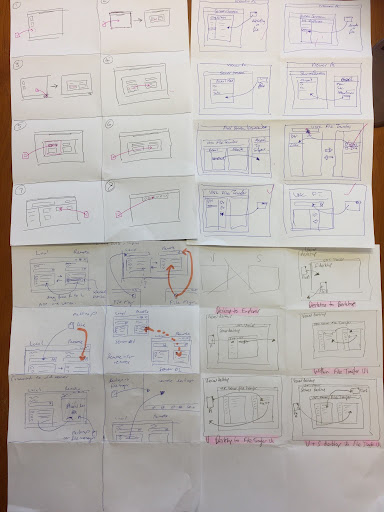
After gathering a range of ideas, I synthesised the best elements into wireframes. These were shared with the team, refined through iteration and prepared for external validation.
Usability Testing & Prototyping
Early on, before mastering modern prototyping tools, I conducted low-fidelity usability tests using printed screens and manual paper transitions. This scrappy but effective method quickly revealed usability issues. As the project progressed, I transitioned to digital prototyping tools like Balsamiq and InVision, eventually adopting Figma as my go-to tool.
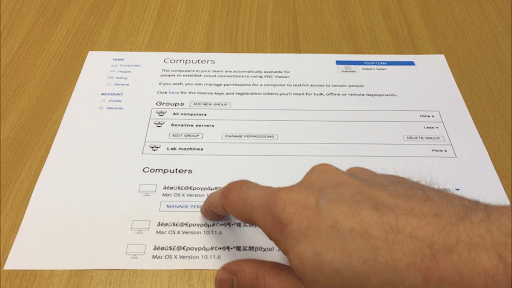
This iterative testing approach ensured that design decisions were informed by real user feedback, rather than assumptions.
Driving a Cultural Shift in Product Development
This was a large-scale redesign, encompassing both mobile and desktop software, as well as a brand-new web portal. More than just a product evolution, it represented a fundamental shift in how the company approached design and development.
Previously, feature requests went straight to developers with little to no user validation. By embedding UX research and iterative design into the software development lifecycle, I helped establish a culture where discovery and design work preceded coding. User research became a core part of decision-making, ensuring that we built solutions people actually wanted and needed.
By the time I left the company, the impact of these changes was clear: UX had become an essential function within the organisation. The fact that they hired a dedicated UX professional to replace me – when the role hadn’t existed before – was a strong testament to the lasting influence of this transformation.
Key Takeaways
- Proactively introducing UX processes can drive significant cultural and operational change.
- Direct user engagement is invaluable in shaping product strategy and design decisions.
- Cross-team collaboration leads to stronger, more innovative solutions.
- Even scrappy, low-tech usability testing can provide meaningful insights early on.
 Mark Boxall